← chintan shingala / home case study 4 of 4
  CASE STUDY — SALARY FINANCE

The first direct-to-employer API — 200,000 employees, live.

Role
PM, Employer Servicing & Payments
Company
Salary Finance — B2B2C fintech, 500+ employers
Client
Sainsburys
Outcome
real-time validation, 200,000+ employees

The situation

Salary Finance products live and die on employment data: loans repaid through payroll only work if you know who is employed, at what salary, right now. That data arrived from employers as periodic files — workable, but always behind reality. The Sainsburys integration was the company's first direct-to-employer API: live validation, live salary data, leavers known the day it happens. I wrote the technical and functional specs, designed the backend flow, and delivered within the timeline.

note: visuals on this page are redrawn concept illustrations — the real client work stays confidential.

the domain, in a sentence: salary-linked finance lets employees borrow and repay through payroll — which only works if the platform knows someone's employment and salary right now. validation is the heart of the product.
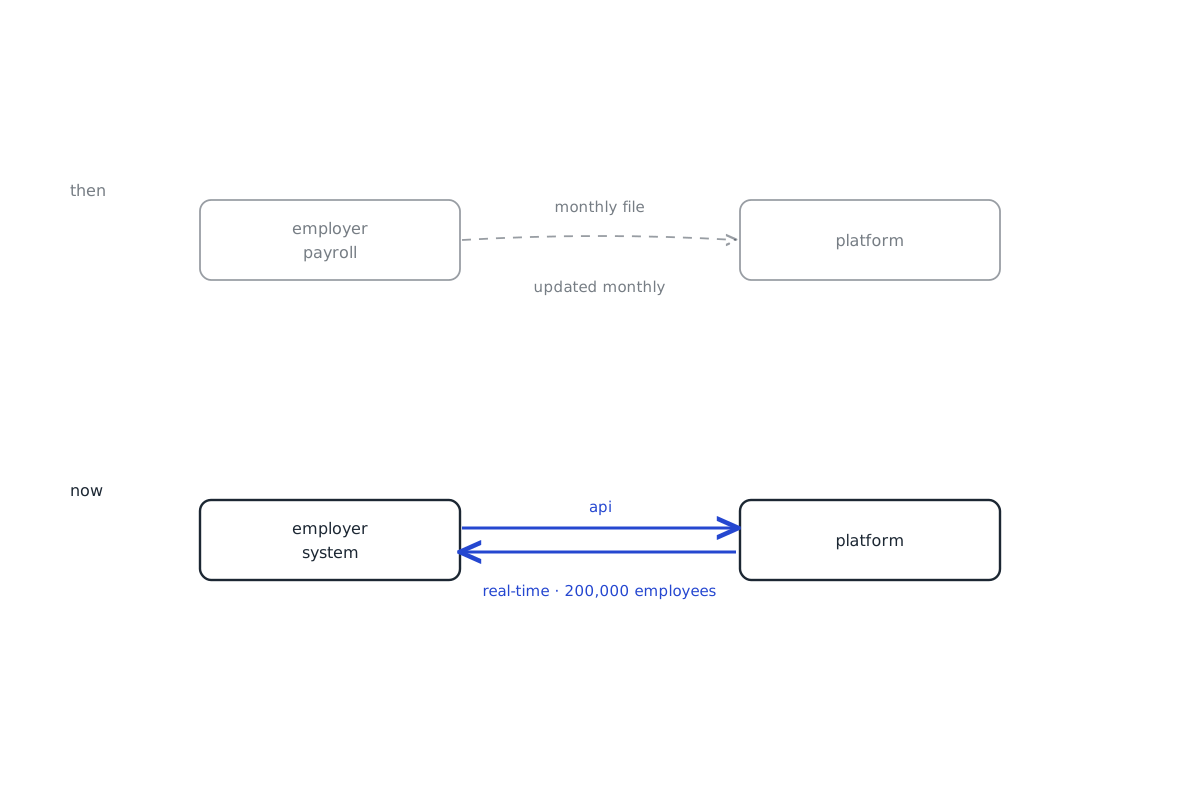
fig. 01 — file to api
Diagram: then — employer payroll sends a monthly file to the platform. Now — a two-way real-time API between employer system and platform, serving 200,000 employees.
decision 01

Don't touch the core — translate to it

Salary Finance already had a validation service at its centre — every product depended on it, and rewriting it for real-time inputs would have put all of them at risk. We also believed employer integrations were the future, not a one-off. So the design was a middle layer: it takes external validation data in whatever shape an employer's systems produce, and translates it into the data points the core service already understands. The core stayed untouched — and the next employer becomes a translation problem, not a rebuild.

the alternative we rejected: extend the core validation service for real-time inputs — one employer's integration bought with every product's risk.
decision 02

When real-time breaks the batch assumptions

The database was built on an assumption nobody had ever needed to say out loud: employer data arrives weekly or monthly. Real-time broke it everywhere at once. We had to define scenarios and statuses that had never existed, decide what a customer should see the moment they became a leaver, and work out which documentation had to trigger immediately rather than at the next cycle. What started as a simple integration build ended as a system redesign for the future of integrated employer data — coordinated throughout with Sainsburys' outsourced Oracle delivery team.

the alternative we rejected: treat it as a pipe — ship the integration and let the rest of the system keep behaving as if data still arrived monthly.

Where it landed

Delivered within timelines: real-time employment validation for more than 200,000 Sainsburys employees, with live salary and leaver data flowing into the platform. It was the first and only direct employer integration at the time — and it became the bedrock of negotiations with the UK's largest employers. The friction that had always hurt renewals was the burden on HR teams of preparing and sending data every cycle; an integration where Salary Finance takes on the technical burden turned that objection into a sell. The same approach was later agreed for NHS trust foundations, covering multiple hospitals across the country.

Real-time data doesn't upgrade a product. It rewrites its assumptions.
from: decision 02